Monday, March 19, 2012

A Blueprint for Escalation

There is a common blueprint for violence on the Gaza border. Either the Israeli's or the Palestinians attack first, and then Qassam rockets and IAF strikes ensue until Palestinians in Gaza decide to stop--to initiate a cease fire. "And indeed, this time Israel carried out a targeted assassination of someone it considered an arch-terrorist – Zuhair Qaisi, the commander of the Popular Resistance Committees – the Palestinians pounded civilian targets with rockets and missiles, Israel responded by targeting terrorist sites, and then the Palestinians – after a few days of fighting – had enough, and quiet was restored. Until the next time (JPost)." 
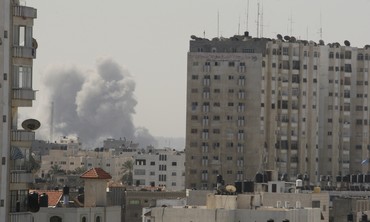

IAF Strike in Gaza REUTERS
Car damaged by a rocket attack in Ashdod REUTERS


It is all too common. This continual cycle of violence which seems to have no end in sight deals a significant blow to civilian populations, and not just in injuries and casualties. Since the informal cease fire on March 13th, over 20 rockets have fallen on Israel from Gaza. During this entire escalation of violence, nearly 1,000,000 people had to endure constant exposure to violence as over 300 rockets fell on Israel in the south. Children and adults in southern Israel were confined to bomb shelters as school closed for hundreds of thousands of students, severely disrupting peoples' lives and livelihood. Sadly, this isn't anything new. It is just one escalation of many, and likely many more will occur. 


Children in an Ashkelon bomb shelter adapted from a drainage pipe AFP


For me it is very difficult to deal with. It prompts me to learn more about the political situation, what diplomatic efforts are being done on both sides of the conflict, and how the recent violence has been portrayed in the media. In an effort to boost views to my blog, I posted it on a public forum. One of the comments I received was that everyone forgets about Najd, the arab village that was expelled in 1948 during the war of independence. Interestingly enough, Sderot was built on top of Najd years later. It seemed that this was supposed to mean that the difficulties of Sderot's residents are unimportant so long as the former residents of Najd are still refugees.


While historically, this may be true, it is wrong to blame the civilians for what happened. Nearly 70 years later, chances are most Israelis haven't even heard of Najd, a small villiage of under 700. Now, with Sderot having a population of over 25,000 people, it is a much different situation. The fact is, most people, in Gaza and Israel, just want to be able to continue to live as normal people, carry on their lives uninterrupted, work, and raise a family. Lets forget about the blame game for a moment. Lets think about the civilians. People need help, Natal is trying to provide it, and I am just trying to get the word out, that there are many here who need help. While typically Palestinians don't ask for help from Natal, they are welcome. In Israel, Post Traumatic Stress is not so atypical. Natal provides help for those who need it, despite age, religion, or political affiliation. 


Natal hears, "Thousands of children and adults have been exposed to consistent violence and many are suffering psychological trauma as a result," and they respond with, "Those who need help, please call us at  1-800-363-363." 


Wherever you stand on the conflict, whether you are far left, far right, center, anti-zionist, zionist, or whatever, it is clear that people need help. 

Friday, March 16, 2012

My Friend Shani's Story in Cleveland News


Beachwood residents Ronna and Joel Fox got a text on the afternoon of March 9 from their daughter Shani with the words, “I’m fine.”
Fox, 20, was visiting a close Israeli friend in Ashdod, Israel, about 25 miles southwest of Tel Aviv, when Palestinian terrorists fired rockets on the coastal town.
“We then went online to see why she might be telling us she’s fine and discovered that there was some activity in the south,” Joel Fox said. “Obviously, any parent would be concerned, but the fact that she texted us, and could do so, and immediately made sure to say ‘I’m fine’ helps you relax right away. We knew she was with friends who were responsible.”
Terrorist groups in Gaza began launching a barrage of rockets on Israel after Israel killed Zuhair al-Qaissi, leader of the Popular Resistance Committees in Gaza. Israel Defense Forces official said they believed al-Qaissi was planning a terrorist strike in Israel. In four days of attack, more than 200 rockets were fired from Gaza on Israel.
At least 27 Palestinians were killed in the Israeli attacks. The majority of those killed were terrorists, including 14 from Islamic Jihad, according to the IDF. At least eight Israelis and foreign workers in Israel were wounded, including two seriously, and dozens have been treated for shock, according to reports.
Shani Fox, a junior at the University of Rochester in New York, is studying abroad in Tel Aviv this semester.
After eating Shabbat dinner with her host family in Ashdod, Fox was talking with her friend about the three terrorists in Gaza killed by an airstrike earlier that day.
“He said retaliations had been started,” Fox said. “He thought we had some time before anything even reached close to here.”
An hour after that conversation, the first airstrike alarm sounded.
“I’ve never heard it before, so obviously the first thing that goes through my mind is not that it’s a siren,” she said. “I thought it was a car alarm. I looked at (my friend). His face went white.
“I knew I was about to experience my first rocket attack.”
Fox and her host family quickly retreated into a bomb shelter. Once the siren quieted down, everyone started listening for the booms.
“We heard six hits,” Fox said. “The last one was very close.”
Over the next 24 hours, six more sirens sounded.
“The family had serious talks about taking me home because they didn’t want me to experience it any more,” Fox said. “The sad thing is that this is their reality. This is their culture; this is part of their life.”
However, the booms they heard during the attack weren’t hits. The sounds came from Israel’s Iron Dome missile-defense system intercepting the incoming rockets.
“It was like a miracle in action,” Fox said. “I was so grateful to those soldiers for that Iron Dome. They’re protecting us without even realizing it.”
Fox said her experience in Ashdod only made her more fired up over the issues surrounding the Israeli-Palestinian conflict.
“It’s not that my views have changed politically about what I want for the future and for peace in Israel,” Fox said. “However, before I was always interested in the news, but I would wait for someone to tell me. These past few days I’ve been only reading news.
“I’m still very grounded in what I believe and what I believe should happen, however, I’m much more involved at this point,” she said.

Monday, March 12, 2012

Fun and Fear: A Revival of Rockets and Purim in Israel

What an interesting week in Israel. So many things have happened. It all began on tuesday, when my program took us on an interesting field trip to Sderot--the city in Israel that is the closest to Gaza.

I have written about Sderot before, but I still hadn’t had a proper tour of the city. Therefore, I will give my personal experience visiting in a few words. Sderot is the hebrew world for boulevard, which is interesting, because I didn’t see so many boulevards, I saw many many bomb shelters. Since residents only have 15 seconds to make it to shelter after sirens go off, the shelters are placed on every street corner, in nearly every home. Even in one of the playgrounds, there was a giant caterpillar shaped bomb shelter that children could run to, and often do. We had the opportunity to speak with one of the residents who lives there and heard about his stories of rockets falling, not having enough time to make it to a bomb shelter, seeing rockets fall in front of his own eyes, and the fear that residents of this town live in.


However, they refuse to leave. If they can be ran out of town by the terror, than it has done its job. The residents know that if they run, they might as well be pushed into the sea. It is a very difficult life, but a very important one. Even with war being an aspect of everyday life, residents choose to stay, amazingly. Even new neighborhoods are being built for immigrants to the city. This city is not dying away, it is growing. It stands in the face of danger, and says “You can try to scare me, to kill me, or to run me out of town, but I am not going. This is my home.” It is truly amazing.

After our meeting, we were taken to the police station to take a look at the rockets that had been retrieved. There were hundreds of them, but those we saw were merely a fraction of those that have hit the town. It left me with a strong impression.


It is amazing that the story of Sderot is not told. The story of Gaza is every where, but the strikes there are all directed at terrorists with an extreme amount of precision, retalitory to rocket attacks on civilian populations in Israel. Gaza militants fire from civilian areas, taking refuge in preschools and homes, in order that when the retalitory strikes come, more civilians die and they can gain face in the media. Further, they fire towards civilian areas indiscriminantly. Luckily, Israel puts billions of shekels into keeping their citizens safe with the Iron Dome system which intercepts Qassams in mid air, in shelters placed strategically all over the border cities and towns, and for the military response which typically causes the rockets to stop, at least temporarily. Sderot is the only city in the world where rocket attacks are carried out directly onto civilian areas on a daily basis. These are not opinions, they are the facts of the situation.
-----------------------------------------------------------------------------------
Anyway, on to the rest of my week. It was easy to forget about my visit to Sderot within 24 hours, because the festivities for Purim had just begun. Purim is the Jewish version of Halloween, but instead of focusing on the scary, it focuses on the miracle of the Jewish people's ability to survive. We wear costumes to disguise ourselves just like the characters in the story of purim--which I will leave out for length's sake.

During Purim, Israel is a massive party. Literally, regular life shuts down, and suddenly the entire country is in Party mode. There are street parties everywhere, music in day and night, people dressed up in costume, plenty of drinking, and plenty of fun.

Tuesday night, two days before Purim properly began, Tel Aviv had a flash mob--specifically a MASSIVE ZOMBIE WALK. Somehow, I got the invite and decided to dress up, put on my undead face, and roam the streets of Tel Aviv with thousands of people, climbing over vehicles, invading pubs and restaurants, climbing on top of monuments, and overall creating massive hysteria in the heart of this lively city.


My Wednesday night--the eve of Purim was pretty interesting as well to say the least. It is customary that on Purim, one drinks enough so that he or she is unable to tell the difference between good and evil (Haman and Mordechai), thus I can assure you, I may still have had my wits about me, but I definetly had the holiday spirit. I went to a party on a roof, invited by a few friends I met from couchsurfing, then I went to a street party behind the nicest dessert restaurant here, Max Brenners, then I hung out with some strangers and went to a club, and then I went home. It was very fun.

Aaand, the next day, my friend Jake and I took a bus deep into the heart of the desert to a place known as the "Desert Ashram." For Purim weekend they were having a festival, the Galactic Rave, where one could meditate, participate in workshops about interesting hippie love and strange ideas, dance your heart out on the dance floor to some of Israel's finest trance music, and meet fun loving people from all over this tiny country.

It was an amazing time. Jake and I went on some interesting walks into the desert, heard some beautiful jams with ethnic instruments from around the world, and had an experience that will be difficult to forget. On Saturday, it was time to go home. I got a ride back to Tel Aviv with some friends of mine from couchsurfing, and on my hungover ride home I had an interesting conversation with my friend next to me. Tsur turned to me during our 4 hour ride home and said, "Isn't it amazing that in such a tiny country, where you can drive north to south in just 7 hours, there is so much to see." He was talking specifically about the nature--the mountains of the golan and the upper Galil, the Jordan river, the rolling hills of the lower Galil, the Green Judaean mountains around Jerusalem, the farmlands and cities next to beaches, the arava desert, the judaean desert, the largest crater in the world, the lowest point on earth (the dead sea), the southern mountains, and dolphin reefs in eilat.

I thought about that quite a bit. It isn't just the nature. It's the people. You can walk through druze, arab, christian and Jewish communities here that are as lively as they were 2000 years ago. You can go to a place like ashram where Israelis that have traveled in the far east and india bring back their experiences and a new way of life. You can party like its New York in Tel Aviv, and you can visit the temple mount of ancient Israel just 45 minutes away.

It is amazing how small this tiny country is.

And just as all this was going through my mind, Israel was under fire just 45 minutes south of me. In the midst of the Purim festivities, over 130 rockets fell on southern Israel. As a result, school in all over southern Israel was closed, and 200,000 students will be staying home until further notice. As I was partying in my pirate costume, children in Sderot, Ashdod, Beer Sheba, Yavne, and many Kibbutzim, were being crowded into bomb shelters while still in costume.

All the while, the Post Trauma hotline at Natal's PTSD center had a 300% increase in calls.  While Tel Aviv was partying, our neighbors in the south were in fear of their lives.

It is terrible. The lives of children are being disrupted every day by the rockets eminating from the Gaza strip. Israel is doing everything it can to stop the terror, but it is a difficult battle to fight. We need everyone's help, we need solidarity. War can't be the only solution, standing together as two peoples who live in fear is enough.

As I said earlier, and I will say again, the story of the communities in Israel under fire needs to be told. The people need help, and the terror must stop.

Sunday, March 11, 2012

Sderot on Fire


Article about Postwar Resilience from International Herald Tribune, 7th Feb 2012

Most Israeli Firefighters Battle PTSD

A new study suggests approximately 90 percent of Israeli firefighters have some form of Post Traumatic Stress Disorder (PTSD).

Ben-Gurion University of the Negev’s Marc Lougassi, a firefighter himself and a doctoral student, discovered 24 percent of active firefighters in Israel suffer from full PTSD, 67 percent display partial PTSD while only nine percent showed no symptoms.

As a result of the research, investigators believe the experience of recurring trauma is a significant factor toward developing PTSD.

PTSD is a mental health condition that is triggered by a terrifying event including injury to oneself or another, or another’s death. Symptoms may include flashbacks, nightmares and severe anxiety, as well as uncontrollable thoughts about the event.

According to Lougassi, “Professional firefighters are frequently exposed to extreme stress during their work in emergency situations. In addition to the physical challenges of firefighting, they must evacuate burned and injured victims or bodies.

“Their involvement in traumatic events exposes them not only to the pressures stemming from the traumatic event itself, but also to post-traumatic emotional expressions that result in secondary traumatization.”

“As far as Israeli firefighters are concerned, there has been no documented evidence of PTSD prevalence, despite the fact that they are exposed to additional traumas such as war and terror strikes,” said Lougassi.

full story at http://psychcentral.com/news/2012/02/24/most-israeli-firefighters-battle-ptsd/35233.html

Monday, March 5, 2012

The Journey is Long

This is the story of Yaffa
"I am sleeping.
I dream that a terrorist is chasing me with a long knife, trying to kill me.
I escape.
I awaken, sweating, my heartbeat is racing. My heart won't stop racing.
I go to work.
I feel like I'm being suffocated and it's hard for me to breathe. My whole body is shaking, out of control. I try to concentrate but I feel nauseous. I try to relax, take a pill and wait for it to pass. Let there be a few more hours of quiet until the next panic attack.

Over seven years have passed since the attack. The terrorist didn't manage to set his explosives off. There were no fatalities and no one was injured physically. But since then I have been suffering from anxieties that have only worsened. I don't feel safe anywhere. People don't understand what an emotional wound is. I have to struggle to keep functioning and I feel so alone. I have loads of friends, but when it's hard for meI have no one. When it's hard for me I am alone.

I see the world outside so beautiful and pleasant: Blue skies, trees, flowers, birds. But the world within me is not as beautiful as the world outside. The world within me is black, full of fear and death and a bottomless anxiety with no end in sight. I need to use all my strength to survive. It is hard for me to be strong when I'm shattered inside. Sometimes life looks so black. An infinite darkness of coping and hardship and frustration.

From within this darkness, Mikie, the Hotline volunteer from NATAL, is like a small shining star which lights the way. When I feel that I have no strength to go on, she supports and strengthens me. When it's hard for me, she reminds me that I am strong enough to go on. When I didn't know how to even understand these problems that fell upon me, she helped me find ways to relax and supported me in the fight to be recognized by the National Insurance Office. After six years of being unable to, she managed to help me learn to stay home alone at nights. She always reminds me to focus on the things I have managed to do. Even when I fall again and again, she never gives up on me.

Thanks to her I have managed to cope with therapy and to succeed in it. I work (as a volunteer) all the time between hours of light and beauty and peace and between hours of stress and discomfort.  I work so much, to the point where I feel completely detached. And within this detachment, for already two years now Mikie has been providing me with a stable base. I continue to struggle to enable myself a happier and calmer life, and the journey is long.

I want to say thank you from the bottom of my heart to Mikie and to NATAL for the continued support which keeps me alive and gives me the strength to continue."


This story is from natals website, where it and stories like it can be found at
http://natal.org.il/english/?CategoryID=260