It's strange. I remember writing my first post on this blog about unpacking my bags, excited for my new life in Tel-Aviv. Here I am, months later, writing a post about packing up.
This year has been hands down, the most powerful time of my entire life. Everything I knew as normal has been turned upside down. I see the world in a different way, having met friends who span the entire globe who feel like family at this point. While being here in Israel, I got to volunteer for an organization who I believe to be one of the most important in this country. When signing up for my volunteering, I wanted to work somewhere that provided a neccesary service to Israel--something that truly made a difference. While I wasn't the man behind the screen, taking care of patients, I truly feel like I got to contribute to the place, providing an understanding of what it does and how important it is to Israel.
Natal is an organization that was originally founded to help soldiers deal with post-traumatic stress after difficult tours of duty. Eventually, however, it found that people from all across Israel suffer from post-trauma--that it is truly a national disease. Thousands have been effected by terrorism here and by war. Everyone is connected somehow to a tragic accident--whether a family member or a friend was taken, whether it was witnessing a suicide bombing, whether it is living under the shadow of daily rocket fire, or whether it was living in an army base in constant fear of death.
Before getting into what Natal does, one has to ask themselves, "what happens when an entire society is affected by a debilitating psychological illness?" PTSD causes its victims to break down sometimes to the point where they can no longer live normal lives, unable to work or raise a family. It causes people to hate. It confuses people. So if an entire society that constantly lives under the threat of war and terror fails to develop resiliency through trauma, then they will break down. Peace in the middle east, if however possible, will also fail. Finally, hope will fail, and when hope fails, all else is lost.
I came to Israel with all sorts of opinions about the conflict, but as I learned more and more, I came to find that there is no perfect stance. There is a war of values, of how the history is to be written, and a real war on the ground. I find today, that I can lean one way or the other on any given day. When you look at this conflict on a deeper level, and try and comprehend the way that the average person lives through it, it brings about completely different emotions. People are driven to find revenge. The effects of Post-Trauma are poisonous, and they breed hate. We can try to create political solutions, but they can only help so much. So long as both sides harbor hate and seek revenge for each others actions, prospects of peace--a real lasting peace where both sides can work together for a better future--will break down.
Since working here, the way I travel has changed. When hiking in the Golan heights, I could not get the thoughts of the wars out of my head. I saw ruins of villiages, and I felt compassion, but at the same time, a complete understanding that things are just screwed up. The only way to alleviate the pains is to treat the scars.
I remember staring at the blades of grass around me as I sat eating lunch. During war, these fields would endure constant artillery fire. They would be burned. They would be trenched. But years later, with sunlight and rain, they grew again, and look as much the same as they did before.
War can change things. Lands will change ownership. People will be hurt. However, the only way to get past what has happened is to heal, to grow. We may not be able to find a political solution any time soon. However, we can change the way we think. We can heal from what happened to us. We can forgive. We can be resilient. If we are strong, and don't allow the trauma to kill us, we can learn from it and grow taller than we have ever been.
Israel lives in constant turmoil, but somehow is in the OECD, boasts some of the best technology in the world, has a somewhat decent economy, and a democracy. If we had allowed the Holocaust and all of its trauma to break us down, we would be dead. However, after thousands of years of persecution, we decided to rise up and create something for ourselves--and we sure did. So long as we can learn from our pain, and use it motivate us, anything is possible--even peace.
I want to thank Natal so much for the opportunity it gave me to reflect on Israeli culture, Jewish culture, my perspective on life, and who I am. I feel now a much stronger drive to help my community. I feel much more compassionate to those who hurt. They say, "your only as strong as your weakest link." Therefore, it is our duty to strengthen those of our society who are hurt, broken down, and unable to move on. It is our duty to grow.
Monday, May 14, 2012

Thursday, May 3, 2012
Remembering and Growing: Israel in 2012
From Yom Hashoah to Yom Hazikaron to Yom Haatzmaut, the Israeli spirit lingered in the air. Each holiday celebrates something unique, but all of them are very much intertwined. The basic idea was to remember the fallen--in the Holocaust, in Israel’s wars, and from terrorism--and for the memory of their lives to remind us of the cost that Israel has endured in order to exist. Through the week, I looked back at the year behind me and how my perceptions about this state has changed.
I came here with all sorts of notions, uncertainties, and opinions, but as I became more educated and had the opportunity to see this place with my own eyes, I found it much harder to take a stance on the conflict. I looked around me saw extremism, war, hatred, and terrible memories on the faces of people I saw.
Trauma has truly become a part of Israeli culture. Every person you talk to has a story of a loved one who has fallen in battle, a friend who has been taken by terrorism, or about a community learning to cope with constant rocket fire. Hearing such things evokes a lot of emotions. However, ef we are unable to control those emotions, the prosperity of this country is in danger. We must have hope. Hope lead to the creation of this country, to the survival of the Jewish people, and hopefully one day will lead to peace. In order for this country to truly flourish--to actualize to its full potential and solve its problems--it must face its dark history and learn to grow from it.
During Yom Hazikaron--Memorial Day, my program gave me the opportunity to go visit a military cemetery. While there, they gave us rags and memorial candles, in order that we find an unattended grave, and take care of it (a great deed in Judaism). Upon entering the cemetary, we found thousands of people with smiles on their faces. It looked more like the scene of an art fair than a memorial service. I walked through isles of graves, but I couldn’t find a single one that hadn’t been attended to. Every grave had a soldier and a family in front of it, with flowers and stones all over it, and a memorial candle or two on the side. So I walked around as a spectator, a visitor, just as I have been for 8 months now.
Eventually, as expected, I heard a siren--indicating the moment of silence. Suddenly, the crowd that seemed so uplifted turned somber, as the thousands of people around me looked down and closed their eyes. Soldiers put up their salute. Everyone was quiet for two minutes. It was truly moving.
The same thing happened during Yom Hashoah.
I was walking through the street on the way to Natal, and the siren went off. The bustling traffic came to a dead halt as everyone got out of their cars at the biggest intersection near me, and stood in silence to remember the fallen. I saw no fear in anyone's face. I saw hope. I felt hope. The Jewish people have come so far, from exile after exile, to pogrom, to holocaust, to war after war, and now, in 2012, we are as strong as ever. We have a country, and we can very much be Jewish without being religious.
He said, “Yeah. On several occasions I have just barely missed a rocket attack. If I had been a few meters away, there's a chance that I wouldn't be here today talking to you. It is very difficult living there. With the raids overhead nearly every day, we live in constant fear. It is difficult to live a normal life.”
I told him how I volunteer for Natal, an NGO that provides treatment for victims of PTSD.
He told me, “That’s great. But come live in Sderot, and you won’t have to be a volunteer for any organization. Just living here you become one. We help each other. If we didn’t have our neighbors, we would be in shambles. I am a religious man, you can see by the kippa on my head. I feel safe, because I have hope. I trust that there is someone looking out for me, for my friends, and for my family.”
At that point we split. I saw my best friend enacted into a military which is defending those residents in Sderot. With all the smiling faces, the parents taking pictures, and soldiers making an oath, I felt something special. There truly is someone watching over them. There is the army. There is Natal. There is us--the Jews outside Israel, the common Israeli, the Jewish people. We are strong today and for a while from here on out, watching over each other just as we have for thousands of years. Through all the suffering, hardship, and trauma, we have held each other’s hands, and asked how we could help. In 2012, as small as the Jewish people are are, as dwindling as their population is, we aren’t going anywhere. Just as Israel has opened its hand to any Jew in despair, in search or refuge or a fresh beginning, we must open our hands to the Israeli who suffers, who lives in despair, and who needs help. That’s what Natal is here for.
I came here with all sorts of notions, uncertainties, and opinions, but as I became more educated and had the opportunity to see this place with my own eyes, I found it much harder to take a stance on the conflict. I looked around me saw extremism, war, hatred, and terrible memories on the faces of people I saw.
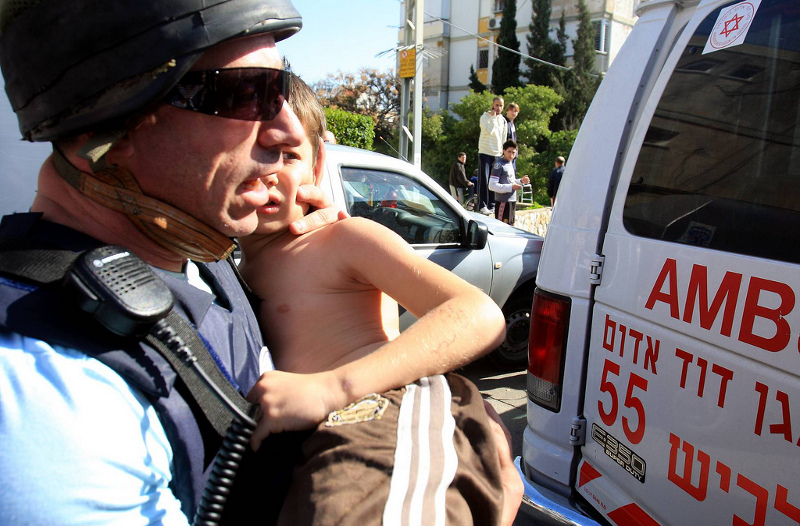 |
| An Israeli Child Wounded from A Rocket Attack is Taken to an Ambulence |
Trauma has truly become a part of Israeli culture. Every person you talk to has a story of a loved one who has fallen in battle, a friend who has been taken by terrorism, or about a community learning to cope with constant rocket fire. Hearing such things evokes a lot of emotions. However, ef we are unable to control those emotions, the prosperity of this country is in danger. We must have hope. Hope lead to the creation of this country, to the survival of the Jewish people, and hopefully one day will lead to peace. In order for this country to truly flourish--to actualize to its full potential and solve its problems--it must face its dark history and learn to grow from it.
During Yom Hazikaron--Memorial Day, my program gave me the opportunity to go visit a military cemetery. While there, they gave us rags and memorial candles, in order that we find an unattended grave, and take care of it (a great deed in Judaism). Upon entering the cemetary, we found thousands of people with smiles on their faces. It looked more like the scene of an art fair than a memorial service. I walked through isles of graves, but I couldn’t find a single one that hadn’t been attended to. Every grave had a soldier and a family in front of it, with flowers and stones all over it, and a memorial candle or two on the side. So I walked around as a spectator, a visitor, just as I have been for 8 months now.
 |
| Israeli Military Cemetary |
Eventually, as expected, I heard a siren--indicating the moment of silence. Suddenly, the crowd that seemed so uplifted turned somber, as the thousands of people around me looked down and closed their eyes. Soldiers put up their salute. Everyone was quiet for two minutes. It was truly moving.
The same thing happened during Yom Hashoah.
I was walking through the street on the way to Natal, and the siren went off. The bustling traffic came to a dead halt as everyone got out of their cars at the biggest intersection near me, and stood in silence to remember the fallen. I saw no fear in anyone's face. I saw hope. I felt hope. The Jewish people have come so far, from exile after exile, to pogrom, to holocaust, to war after war, and now, in 2012, we are as strong as ever. We have a country, and we can very much be Jewish without being religious.
A Highway Stops completely for Yom Hashoah's Memorial Siren
One thing I have learned while being here is that Israel, whether you like it or not, is today the global center of Jewish culture. I’ve recently been reading a book recently called Far From Zion, in which the author travels the globe studying the Jewish communities in the strangest of places. He wished at the beginning to do this in order to prove that the Jewish people doesn’t need to be binded to the Zionist state of Israel. However, everywhere he went he found Israel. Every dwindling community that had been forced to go through generations of oppression was mostly in Israel or fully assimilated. Every prosperous community was keeping Israel in mind. Most of all, even in Africa, Bosnia, and Burma, the Jews prayed in their synagogue in the direction of Jerusalem. Because of this country, we are as much together today as we have ever been.
But we cannot forget the costs. Israel cannot forget dreams of peace and “crush our enemies” forever. We need to find lasting solutions. It is very difficult, as nearly anyone here can tell you, and at times it very much seems impossible. However, we must never lose hope. In order to address a solution, we must first address our own problems. Hundreds of thousands of citizens are under fire by rockets on a sub-regular basis. Thousands are still having difficulty managing horrific memories of war and terror. Just as the Jewish people were able to rise above their difficulties in order to create the State of Israel, we must heal from our wounds so that we can move on to greener pastures.
Thousands of families have been torn apart when their husbands, wives, and children have been taken in battle or in terror. If their pain goes untreated, they could be unable to function as a member of society--dealing many negative consequences to Israel's ever-changing status quo. As much as the atrocities have hurt us, we can not allow them to break us down. PTSD can totally stop you from maintaining relationships, from sleeping, and even from operating in a work environment. Israel must learn from its pain, and grow.
 |
| Between 74-90% of Sderot Children Display Symptoms of PTSD |
Yesterday, on the way to my friend’s initiation ceremony into the Israeli army I met a man on the side of the road going the same way. We walked from the bus stop for a good half hour, discussing this very subject of PTSD. He was from Sderot, the city bordering Gaza that has been constantly exposed to violence for over ten years. I asked him about the rockets, and how they affect him and his community.
 |
| A House in Sderot Damaged by Rocket Fire from Gaza |
He said, “Yeah. On several occasions I have just barely missed a rocket attack. If I had been a few meters away, there's a chance that I wouldn't be here today talking to you. It is very difficult living there. With the raids overhead nearly every day, we live in constant fear. It is difficult to live a normal life.”
I told him how I volunteer for Natal, an NGO that provides treatment for victims of PTSD.
He told me, “That’s great. But come live in Sderot, and you won’t have to be a volunteer for any organization. Just living here you become one. We help each other. If we didn’t have our neighbors, we would be in shambles. I am a religious man, you can see by the kippa on my head. I feel safe, because I have hope. I trust that there is someone looking out for me, for my friends, and for my family.”
At that point we split. I saw my best friend enacted into a military which is defending those residents in Sderot. With all the smiling faces, the parents taking pictures, and soldiers making an oath, I felt something special. There truly is someone watching over them. There is the army. There is Natal. There is us--the Jews outside Israel, the common Israeli, the Jewish people. We are strong today and for a while from here on out, watching over each other just as we have for thousands of years. Through all the suffering, hardship, and trauma, we have held each other’s hands, and asked how we could help. In 2012, as small as the Jewish people are are, as dwindling as their population is, we aren’t going anywhere. Just as Israel has opened its hand to any Jew in despair, in search or refuge or a fresh beginning, we must open our hands to the Israeli who suffers, who lives in despair, and who needs help. That’s what Natal is here for.
 |
| Me With Franco After He Was Initiated Into the IDF Tank Unit, Shirion |
Thursday, April 19, 2012
Yom Hashoah--Israeli Holocaust Remembrance Day
Last night I had the opportunity to hear a survivor speak at a synagogue in Tel Aviv. I have heard several speakers before, but never in Israel on the eve of Yom Hashoah. It was truly a touching experience. The stories he had were gruesome. The horror that he had to endure, the nightmare he went through, is very difficult to grasp.
He said to us, "Every town the Germans encountered, they asked all the Jews to pack two suitcases and head to the center of town where they were picked up by trucks, and then, they disappeared." When his family heard news that the Germans were coming they packed a couple potato sacks with food and clothing and fled to the woods (Suitcases would lead people to believe that the family was Jewish rather than peasants). They knew if they were caught, they would be shot on the spot. They were actually caught on a couple of occasions. His father was killed, he was kept in a prison for two weeks, until they escaped the night they were to be shot, and they hid in a wine cellar for two years. In they end he survived, and made it to Israel.
However, he could not escape his nightmare, as he called it. It was literally a nightmare. He said every night he could not escape dreams of Germans chasing him, shooting him, stabbing him, torturing him, murdering his mother, father, strangers. In the army, his unit couldn't stand him because he woke them up every night when he would scream awake from his dreams. He could not escape the pain. He had PTSD. Not until he went to a military drill, where he ran, screaming as artillery fired into the air and shrapnel pierced his chest, did he escape his pain--when he knew that he was safe, that his mother was safe, that the Jewish people who have endured so much trauma, were safe as long as soldiers like him were fighting to protect this nation.


Yad Vashem.
Yom Hashoah has been a national holiday since 1953, enacted under Prime Minister David Ben Gurion. It's date differs from the International holocaust remembrance day because Ben Gurion wanted to lead it into Yom Ha'atzmaut--Israel's national independance day. Here, the Holocaust and Zionism are very intertwined. In fact, the full name of the rememberance day is Yom HaZikaron laShoah ve-laG'vurah, literally meaning Holocaust and Heroism Remembrance Day. It reminds us of Jews who saved their own lives, saved their children's lives, as well as the many non-Jews who risked their lives in order to save another's--something I, and the entire state of Israel is very greatful for.
But remembering is not enough, we must reflect on what Yom Hashoah means today for the Israeli people. After the Holocaust nearly 250,000 Jewish refugees from Europe tried to make their way to then British Mandate Palestine. Many didn't make it, whether they were lost at sea, or turned away by the British, all the while carrying with them a nightmare that can never be forgotten. When Israel was founded, they had two options--the same two options that some Jews had--to kill, or to be killed. As tragic as this may seem, it was the truth. Even today, the majority of Israel's neighbors do not except her existence, and wish to see the state destroyed. In the face of adversity, Israel won the war, being one of the first times that the Jewish people resisted their own destruction, and changing the face of the Jewish people.

Exodus Ship Carrying Refugees to British Mandate Palestine.
Israel chose not to make their holocaust rememberance day on the same day as the international holiday because it is held on the date of the liberation of Auschwitz. Ben Gurion didn't want the day to be about remembering our suffering, but about learning from it, and how we can learn to defend ourselves. There was a lot of shame involved in WWII with the Jewish people. It is the same shame that we had from the pogroms--that our people went like sheep to the slaughter without running, fighting, or generally resisting.
We remember the holocaust to ensure that it never happens again, that Israel can always defend its people.
This sense of shame is discussed in Nachman Bialick's 1903 poem, "In the City of Slaughter," which reflected on the Kishinev Pogrom of Russia where 50 Jews were killed, 500 injured, and over 700 homes and business ransacked. He wrote:
"Crushed in their shame, they saw it all; They did not stir nor move; They did not pluck their eyes out; they Beat not their brains against the wall! Perhaps, perhaps, each watcher had it in his heart to pray: A miracle, O Lord,—and spare my skin this day! Those who survived this foulness, who from their blood awoke, Beheld their life polluted, the light of their world gone out— How did their menfolk bear it, how did they bear this yoke? They crawled forth from their holes, they fled to the house of the Lord, They offered thanks to Him, the sweet benedictory word. The Cohanim sallied forth, to the Rabbi's house they flitted: Tell me, O Rabbi, tell, is my own wife permitted? The matter ends; and nothing more. And all is as it was before."
Watching their daughters and wives getting killed and raped, they hid and did NOTHING. They went to their Rabbi to ask if their wives were still pure to sleep with. They said thank you to G-d. They said prayers, and acted as if nothing ever happened. The aftermath caused an public outcry for Zionism, that the Jewish people need somewhere to go, to stand together against their enemies.
In this way, Zionism is a movement to protect us--to be the shield of the Jewish people. Today, if a pogrom were to occur, Israel would be there right away to protect the Jewish people. In a way, this movement has been founded as a result of the Post-Traumatic stress of the Jewish people.
Natal, the Post-Trauma organization that I volunteer for, says that they are here to treat the "National Disease" that is PTSD in Israel. Today, nearly everyone has been affected by the Arab-Israeli conflict, whether by terrorism or by war. But this trauma stems deeply from our roots. We have never escaped it. It is entrenched in the Jewish heritage all across the world. The Jewish people have had to learn to endure trauma after trauma as generations in exile beat down on us in the harsh form of pogroms, death camps, book burnings, scapegoating, ghettos, forced labor, and separation of families. The entire Jewish people were ran out of Israel over 1000 years ago, and forced into many nations who never welcomed them.
Today, things are a lot different, and I believe it is due to the free nature of the world. We say never again, and I truly believe that so long as the State of Israel exists, it will never happen again. It is because we can fight back. It is because today, Israel has one of the strongest armies in the world. In fact, when Ben Gurion first thought of creating the Yom Hashoah, he wanted it to be on the anniversary of the Warsaw Ghetto Uprising. Yom Hashoah reminds us of the historical change we made as a people.
Today, Yom Hashoah reminds us of the 6 million who perished, but it also reminds us of the necessity for this state of Israel. No matter what, the Jewish people are here to stay. We have issues, the conflict is as complicated as ever, but one thing is for sure--we are here to stay. We must learn to cope with the trauma that continues to plague us. We must learn to grow from our history, to be stoic, and to help those around us who suffer from the result of trauma. Just as Israel was there to provide help for Holocaust refugees,we must provide help for those suffering from trauma today.

Natal's Center for Victims of Terror and War is here to help.
Monday, April 16, 2012
Hiking the Golan Heights
Last week was Passover, a holiday which is very important to the religion of Judaism. Our program gave us a week long break to do whatever we want--to travel, to visit family, or to just relax. My cousin and I decided that we were going to backpack through the Golan Heights with our friend Itai. It ended up being much more than a pretty hike. It turned out to be an extremely thought provoking experience that I will never forget.

I always have thought of the Golan Heights as Israel's northernmost wilderness. I never knew much about it other than that it borders with Syria, has beautiful mountains and streams, and is mostly land which hasn't been built on. As it turns out, the Golan Heights is rich with history--Jewish, Syrian, and Turkish. It has endured many wars, and is still considered sovereign Syrian territory according to the international community, but Israel disputes this. It is basically a massive rocky plateau formed in the Anti-Lebanon mountains, supplying Israel with a third of its drinking water and drawing nearly 3 million tourists each year.
Before the Six Day War in 1967, Syria, perched on the edge of the Golan heights peering into the Galilee, was shooting artillery and sniper fire indiscriminately at civilian populations. When the war began, Israel had two options, sit in the galilee and get bombed to oblivion, or push the Syrians out of the Golan heights and down to the other side. Somehow, Israel did it, but with many consequences. There were around 100,000 Druze and Circassian refugees which fled deeper into Syria, with only 7,000 Druze staying back. At first, after the war, it was clear that Israel would eventually give back the golan in a peace agreement, but it never happened. Some 5 prime ministers have offered to give up to 97% of the Golan back in exchange for a comprehensive peace agreement, every time Syria has declined, refusing to accept the existence of the state of Israel, and refusing for any of the Golan to be under Jewish control. President Bashar al-Assad said "The Golan Heights is all Arab, and will always be Arab."

Cartoon from a Syrian Newspaper pre-1967
After years of broken down peace talks, another war began. In 1973, the Arab nations initiated a war against Israel on all sides, to destroy the Jewish state. It began on the day of Yom Kippur, the holiest day for Judaism when all the people were fasting and praying. After a brutal attack on the Golan, Israel ended up somehow surviving, pushing Syrians deep into their territory. After this war, the Golan has been considered very much Israeli by the populations here. They have established 41 settlements, resurrected ancient Jewish ruins and synagogues, and have made an effort to make the area more Israeli. Today 10% of Druze residents have accepted Israeli citizenship.

This gets me to the trip. We began in Majdal Shams, a villiage of 8,800 people, the largest population center in the Golan heights. It sits on the southern foothills of the Hermon Mountain. It was a beautiful city. Knowing the situation before leaving, I expected to see a completely Arab town. However, upon arriving, I noticed that nearly every storefront had Hebrew written on it rather than Arabic, even though the population was clearly Arab Druze. We tried to get a taxi, but there were no taxis here. We were in the country. So we started our 125 Km hike from the city, missing the first 3 km down the Hermon.
We passed through 3 Druze villages during our trip. The second two villages were Mas'adeh and Buq'a'tah. As we walked up and down the mountains, through scores of vineyards, olive groves, and almond trees, we encountered several local farmers, all of whom were very friendly and helped us to navigate when we were lost. I was amazed at the friendliness of the Druze people, so many of whom were so excited to meet us American hikers. While at a convenience store in Buq'a'ta, I spoke with the cashier as I purchased some mars bars and pasta. She asked me in Hebrew, "Are you american?" I said yes, of course. She said, "cool, I am Israeli." As basic as this sentence was, and as normal as it may seem, it blew my mind.

Walking through Buq'a'ta
Buqata was Syrian for nearly 90 years. It's civilians link back to Syrian culture for countless generations. But this cashier called herself an Israeli. The signs in the town were written in Hebrew. So it has been 45 years that Israel has occupied the Golan heights. These days, it is seeming like it will never be given up, that a comprehensive peace with a war torn Syria may be impossible for the time being. Buqata today, and Majdal Shams seemed very much Israeli to me. The Wikipedia page says that the Golan Heights are still considered Syrian to the international community, but come there today and tell me that again.
The thing is, you see this region on a map, with dotted lines all over the place and no solid borders, you imagine a war torn region. You can see it here too. Everywhere you walk, there is a minefield likely within a couple hundred meters. Nearly every expansive view includes ruins of settlements and farms, ancient and recent, as well as an abandoned tank here and there. However, it truly isn't as intense as it seems. I think it's actually the most serene and relaxing place that I have visited during my time here in the middle east. People here are very kind--both the Jews and the Arabs, as far as I can tell you. I encountered no hostility. I could understand if I got into a heated conversation with a local about the conflict, things could get hairy. They may show solidarity with the refugees. But I understand. It is terrible that so many people have been negatively impacted by the regional wars. As much as everyone would like to find a solution, where peace is born, everyone is happy, and all rightful ownership of property is restored, that can never happen.

So many people see the conflicts here and think they have the solution. They think there is an aggressor and a defender. But I can tell you something, after 9 months here I have no solution. The lines of right and wrong, instigator and bystander, aggressor and defender are very blurred. I don't think anybody here has a solution. It may be one of the most complicated conflicts in the world. All we can be sure of is who the ruling power is right now. Take a look at history and notice one thing. The focus of power changes all the time. People learn to live and to cope. Life goes on.
Moving on, past Buqata, we found the border with Syria. Well.....not exactly a border actually. Since the armistice agreement of 1981, there exists a huge buffer zone between Israel and Syria which is occupied by the United Nations. Actually, the peak of the Hermon mountain is there. This view that we saw was absolutely stunning. It is actually why the Golan is such a strategic area. From the Golan plateau, one can see the entire length of the Syrian border and peer into all of its border cities. The horizon stretches all across the plain, and all of it is Syrian. With binoculars, on top of Har Bental, a mountain whose army base was the most strategic point in winning the Yom Kippur War, we could even see Al Quneitra, a ghost town in the demilitarized UN zone, which once housed 20,000 residents.
The Story of Al Quneitra is pretty amazing. During the '67 war, Syrian troops stationed in Al Quneitra received bad intel from the Syrian Army command that the troops were retreating. In a quick last second move, the soldiers left their tanks, evacuated the city, and retreated. That day, Israel rolled into the city expecting one of the biggest battles on the Syrian front, only to find thousands of empty houses, cars, and tanks. When Israel gave the city back in the UN brokered armistice agreement, Syria decided to keep it abandoned as a memorial to the war.


We actually had another opportunity to walk through a destroyed Syrian army base.

Just as the Syrian residence in this place was so apparent, so was the Jewish residence. That night we camped at an Israeli settlement built near the ruins of an ancient Jewish settlement which existed during the tribal period of Israel, before the creation of Jerusalem. The settlement of Keshet today exists isolated in an area surrounded by uncultivated land that extends to the horizon.

The next day we camped next to a Mikvah near the ancient Khurva Sinagogue which overlooks a beautiful valley which extends into the Galilee.

We saw many of these clear examples of ancient Jewish residence in the Golan heights--a fact which has lead many far right politicians to demand that Israel officially annex the Golan heights.
After writing all about my long distance hike in the Golan, you must be asking yourself, what is this doing in a blog about Post-Traumatic Stress. This hike placed me in an area which Israel occupies, which is disputed over. Thousands of lives have been lost over the battles for who controls this strategic area. Today, Israelis consider the Golan heights very much a part of Israel, considering the costs it has been forced to endure in order to keep this sliver of land.
The Golan heights exemplifies the very real phenomenon of Post-Traumatic Stress in this region of the world. There is no escaping the war that exists there. I was forced to follow a trail where in parts, everywhere around me were mine fields surrounded in barbed wire, and there was only one path. The way that an Israeli would interpret the things they see here could evoke anger, nationalism, or general apathy which would lead him or her to try to leave this volatile region. To me, this sounds like basic symptoms of PTSD.
It might not be a serious personal problem. It is, however, a serious national problem. I hope that things can change. That everyone here will rise above their differences, overcome hate and paranoia, and ensure lasting peace of nations, of mind, and prosperity. I'm not sure what is to come.

Passover commemorates our exodus from slavery and our beginnings as a people brought together by common hardship. This situation in which our hardships keep us together as a people, even in exile, has repeated itself time and time again throughout history. It is probably the reason that Jewish people still exist. Whether it was living as slaves under an ancient king, surviving in a wild desert, being oppressed by foreign nations in which we lived, surviving a genocide, or trying to create a country in a region which doesn't welcome us, the struggles that the Jewish people have endured have been the events which have brought us closest together. Together, we can help alleviate our mental angst. We can give our hope, our love, and try our best to understand. This trip brought me one step closer.
Monday, April 2, 2012
Interviewing a Hotline Specialist
A while ago, during my internship at Natal, I was given the opportunity to speak first handedly with one of the psychologists who works for Natal's Stress Hotline. As I have spoken about before, Natal's hotline is a toll free number that anyone can call in times of stress, including wives and children of soldiers, soldiers themselves, or those associated with or affected by terrorist attacks. The woman who I got the opportunity to speak with was Sigal, a very sweet woman with a soft voice and a good sense of humor.
For some reason, I had expected something else. I assumed that a psychologist volunteering to help these people must somehow be stern and blank faced, offering intillectual insight while holding their emotions behind a glass window. Considering the weight of all the stories they hear that must take a toll on their own emotional and psychological health, I couldn't understand how a person who listens to first hand accounts of extreme psychological trauma could be so enjoyable to be around. But Sigal was very even tempered, and her smile assured me that she was doing a good job to help her patients.
Typically when I hear the word hotline, I think a number you call when you are really freaking out, to keep you from doing something dangerous. However, Natal's service is more than that. It is real therapy.
She described the process of treatment to me. By first call, Natal Hotline Psychologists determine the therapy treatment according to the severity of a patient's case. Sometimes, one call is just enough, as a child tries to cope with a father's emotional unavailability and earns the insight to deal with the issue from the call. In order to make sure, Natal calls back the patient to make sure everything is alright, a procedure that make Natal unique. In other cases, patients develop a longer term over-the-phone therapy which can last weeks, months, or even years, in which hotline specialists reciprocate phone calls with the distressed individuals.
Sigal told me that during a difficult time in Israel, such as one of the heights of the second intifada or during increased Gaza rocket fire, calls increase. It can be expected immediately after watching the news. Sometimes even, the hotline hears about the attacks before they make it to the headlines.
PTSD really is a national disease here. A nation who has learned that terrorism is not all that unlikely, and the same goes with war. Sigal told me that she has and still is treating people who still suffer from trauma after many many years from Israel's multitudes of wars. She told me that even a man who fought in Israel's war of independence in 1948 was in treatment.
After he had fought in 1948, and was forced to surrender Jerusalem, he felt ashamed. The Jordanians held him captive for several years as a Prisoner of War, and when he got out he didn't want to deal with the trauma. He left Israel and met a wife in England, and eventually moved back here to Israel in his late adult life. Even as an old man, he found himself dealing with the effects of PTSD, having difficulty dealing with his wife's Parkinson's disease and finds himself screaming at her. So in 2008, 60 YEARS after the war, he finally decided to seek treatment. Since then he has found a new love, and is actually improving--even after so much time.
This brings a bit of light into the society of Israel. It used to be unacceptable to deal with the problems of trauma--it was looked upon as a weakness since the country has constantly dealt with war and terror. But today, when it's finally socially acceptable to deal with you problems, thousands from across the country who have dealt with trauma for a significant portion of their lives are seeking help. It's beautiful. I'm so glad that there is a place that can help.
I can see it. I have been here for nearly seven months now. The culture here seems electric, there is an abundance of music and art, but still the souls seem to be shocked. There is a certain tension here that I can't seem to forget about. Every one is in on this. Israel is still a country with a lot of enemies, with a lot of violence in their history, and a still uncertain future. The stress needs to be relieved. Without a gateway to relieve the pain, Israel is doomed. I truly believe that.
At the end of the interview, I asked Sigal if the burden of all the stories of trauma she hears leaves a psychological toll on her. She told me that she herself had dealt with PTSD as her husband was shot down while flying over Egypt. That helping people deal with their own stress, and her learning about the was PTSD works by treating them, helps give her insight on her own issues.
Truly PTSD is in the blood of Israeli society. For the wounds to heal, Israel as a whole has to heal. Some people have the strength to get through their issues, and many of them are at Natal to help. I am glad to be here to witness it.
For some reason, I had expected something else. I assumed that a psychologist volunteering to help these people must somehow be stern and blank faced, offering intillectual insight while holding their emotions behind a glass window. Considering the weight of all the stories they hear that must take a toll on their own emotional and psychological health, I couldn't understand how a person who listens to first hand accounts of extreme psychological trauma could be so enjoyable to be around. But Sigal was very even tempered, and her smile assured me that she was doing a good job to help her patients.
Typically when I hear the word hotline, I think a number you call when you are really freaking out, to keep you from doing something dangerous. However, Natal's service is more than that. It is real therapy.
She described the process of treatment to me. By first call, Natal Hotline Psychologists determine the therapy treatment according to the severity of a patient's case. Sometimes, one call is just enough, as a child tries to cope with a father's emotional unavailability and earns the insight to deal with the issue from the call. In order to make sure, Natal calls back the patient to make sure everything is alright, a procedure that make Natal unique. In other cases, patients develop a longer term over-the-phone therapy which can last weeks, months, or even years, in which hotline specialists reciprocate phone calls with the distressed individuals.
Sigal told me that during a difficult time in Israel, such as one of the heights of the second intifada or during increased Gaza rocket fire, calls increase. It can be expected immediately after watching the news. Sometimes even, the hotline hears about the attacks before they make it to the headlines.
PTSD really is a national disease here. A nation who has learned that terrorism is not all that unlikely, and the same goes with war. Sigal told me that she has and still is treating people who still suffer from trauma after many many years from Israel's multitudes of wars. She told me that even a man who fought in Israel's war of independence in 1948 was in treatment.
After he had fought in 1948, and was forced to surrender Jerusalem, he felt ashamed. The Jordanians held him captive for several years as a Prisoner of War, and when he got out he didn't want to deal with the trauma. He left Israel and met a wife in England, and eventually moved back here to Israel in his late adult life. Even as an old man, he found himself dealing with the effects of PTSD, having difficulty dealing with his wife's Parkinson's disease and finds himself screaming at her. So in 2008, 60 YEARS after the war, he finally decided to seek treatment. Since then he has found a new love, and is actually improving--even after so much time.
This brings a bit of light into the society of Israel. It used to be unacceptable to deal with the problems of trauma--it was looked upon as a weakness since the country has constantly dealt with war and terror. But today, when it's finally socially acceptable to deal with you problems, thousands from across the country who have dealt with trauma for a significant portion of their lives are seeking help. It's beautiful. I'm so glad that there is a place that can help.
I can see it. I have been here for nearly seven months now. The culture here seems electric, there is an abundance of music and art, but still the souls seem to be shocked. There is a certain tension here that I can't seem to forget about. Every one is in on this. Israel is still a country with a lot of enemies, with a lot of violence in their history, and a still uncertain future. The stress needs to be relieved. Without a gateway to relieve the pain, Israel is doomed. I truly believe that.
At the end of the interview, I asked Sigal if the burden of all the stories of trauma she hears leaves a psychological toll on her. She told me that she herself had dealt with PTSD as her husband was shot down while flying over Egypt. That helping people deal with their own stress, and her learning about the was PTSD works by treating them, helps give her insight on her own issues.
Truly PTSD is in the blood of Israeli society. For the wounds to heal, Israel as a whole has to heal. Some people have the strength to get through their issues, and many of them are at Natal to help. I am glad to be here to witness it.
Monday, March 19, 2012
A Blueprint for Escalation
There is a common blueprint for violence on the Gaza border. Either the Israeli's or the Palestinians attack first, and then Qassam rockets and IAF strikes ensue until Palestinians in Gaza decide to stop--to initiate a cease fire. "And indeed, this time Israel carried out a targeted assassination of someone it considered an arch-terrorist – Zuhair Qaisi, the commander of the Popular Resistance Committees – the Palestinians pounded civilian targets with rockets and missiles, Israel responded by targeting terrorist sites, and then the Palestinians – after a few days of fighting – had enough, and quiet was restored. Until the next time (JPost)."
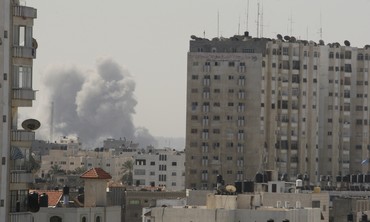

It is all too common. This continual cycle of violence which seems to have no end in sight deals a significant blow to civilian populations, and not just in injuries and casualties. Since the informal cease fire on March 13th, over 20 rockets have fallen on Israel from Gaza. During this entire escalation of violence, nearly 1,000,000 people had to endure constant exposure to violence as over 300 rockets fell on Israel in the south. Children and adults in southern Israel were confined to bomb shelters as school closed for hundreds of thousands of students, severely disrupting peoples' lives and livelihood. Sadly, this isn't anything new. It is just one escalation of many, and likely many more will occur.

For me it is very difficult to deal with. It prompts me to learn more about the political situation, what diplomatic efforts are being done on both sides of the conflict, and how the recent violence has been portrayed in the media. In an effort to boost views to my blog, I posted it on a public forum. One of the comments I received was that everyone forgets about Najd, the arab village that was expelled in 1948 during the war of independence. Interestingly enough, Sderot was built on top of Najd years later. It seemed that this was supposed to mean that the difficulties of Sderot's residents are unimportant so long as the former residents of Najd are still refugees.
While historically, this may be true, it is wrong to blame the civilians for what happened. Nearly 70 years later, chances are most Israelis haven't even heard of Najd, a small villiage of under 700. Now, with Sderot having a population of over 25,000 people, it is a much different situation. The fact is, most people, in Gaza and Israel, just want to be able to continue to live as normal people, carry on their lives uninterrupted, work, and raise a family. Lets forget about the blame game for a moment. Lets think about the civilians. People need help, Natal is trying to provide it, and I am just trying to get the word out, that there are many here who need help. While typically Palestinians don't ask for help from Natal, they are welcome. In Israel, Post Traumatic Stress is not so atypical. Natal provides help for those who need it, despite age, religion, or political affiliation.
Natal hears, "Thousands of children and adults have been exposed to consistent violence and many are suffering psychological trauma as a result," and they respond with, "Those who need help, please call us at 1-800-363-363."

IAF Strike in Gaza REUTERS
Car damaged by a rocket attack in Ashdod REUTERS
It is all too common. This continual cycle of violence which seems to have no end in sight deals a significant blow to civilian populations, and not just in injuries and casualties. Since the informal cease fire on March 13th, over 20 rockets have fallen on Israel from Gaza. During this entire escalation of violence, nearly 1,000,000 people had to endure constant exposure to violence as over 300 rockets fell on Israel in the south. Children and adults in southern Israel were confined to bomb shelters as school closed for hundreds of thousands of students, severely disrupting peoples' lives and livelihood. Sadly, this isn't anything new. It is just one escalation of many, and likely many more will occur.
Children in an Ashkelon bomb shelter adapted from a drainage pipe AFP
For me it is very difficult to deal with. It prompts me to learn more about the political situation, what diplomatic efforts are being done on both sides of the conflict, and how the recent violence has been portrayed in the media. In an effort to boost views to my blog, I posted it on a public forum. One of the comments I received was that everyone forgets about Najd, the arab village that was expelled in 1948 during the war of independence. Interestingly enough, Sderot was built on top of Najd years later. It seemed that this was supposed to mean that the difficulties of Sderot's residents are unimportant so long as the former residents of Najd are still refugees.
While historically, this may be true, it is wrong to blame the civilians for what happened. Nearly 70 years later, chances are most Israelis haven't even heard of Najd, a small villiage of under 700. Now, with Sderot having a population of over 25,000 people, it is a much different situation. The fact is, most people, in Gaza and Israel, just want to be able to continue to live as normal people, carry on their lives uninterrupted, work, and raise a family. Lets forget about the blame game for a moment. Lets think about the civilians. People need help, Natal is trying to provide it, and I am just trying to get the word out, that there are many here who need help. While typically Palestinians don't ask for help from Natal, they are welcome. In Israel, Post Traumatic Stress is not so atypical. Natal provides help for those who need it, despite age, religion, or political affiliation.
Natal hears, "Thousands of children and adults have been exposed to consistent violence and many are suffering psychological trauma as a result," and they respond with, "Those who need help, please call us at 1-800-363-363."
Wherever you stand on the conflict, whether you are far left, far right, center, anti-zionist, zionist, or whatever, it is clear that people need help.
Friday, March 16, 2012
My Friend Shani's Story in Cleveland News
Beachwood residents Ronna and Joel Fox got a text on the afternoon of March 9 from their daughter Shani with the words, “I’m fine.”
Fox, 20, was visiting a close Israeli friend in Ashdod, Israel, about 25 miles southwest of Tel Aviv, when Palestinian terrorists fired rockets on the coastal town.
“We then went online to see why she might be telling us she’s fine and discovered that there was some activity in the south,” Joel Fox said. “Obviously, any parent would be concerned, but the fact that she texted us, and could do so, and immediately made sure to say ‘I’m fine’ helps you relax right away. We knew she was with friends who were responsible.”
Terrorist groups in Gaza began launching a barrage of rockets on Israel after Israel killed Zuhair al-Qaissi, leader of the Popular Resistance Committees in Gaza. Israel Defense Forces official said they believed al-Qaissi was planning a terrorist strike in Israel. In four days of attack, more than 200 rockets were fired from Gaza on Israel.
At least 27 Palestinians were killed in the Israeli attacks. The majority of those killed were terrorists, including 14 from Islamic Jihad, according to the IDF. At least eight Israelis and foreign workers in Israel were wounded, including two seriously, and dozens have been treated for shock, according to reports.
Shani Fox, a junior at the University of Rochester in New York, is studying abroad in Tel Aviv this semester.
After eating Shabbat dinner with her host family in Ashdod, Fox was talking with her friend about the three terrorists in Gaza killed by an airstrike earlier that day.
“He said retaliations had been started,” Fox said. “He thought we had some time before anything even reached close to here.”
An hour after that conversation, the first airstrike alarm sounded.
“I’ve never heard it before, so obviously the first thing that goes through my mind is not that it’s a siren,” she said. “I thought it was a car alarm. I looked at (my friend). His face went white.
“I knew I was about to experience my first rocket attack.”
Fox and her host family quickly retreated into a bomb shelter. Once the siren quieted down, everyone started listening for the booms.
“We heard six hits,” Fox said. “The last one was very close.”
Over the next 24 hours, six more sirens sounded.
“The family had serious talks about taking me home because they didn’t want me to experience it any more,” Fox said. “The sad thing is that this is their reality. This is their culture; this is part of their life.”
However, the booms they heard during the attack weren’t hits. The sounds came from Israel’s Iron Dome missile-defense system intercepting the incoming rockets.
“It was like a miracle in action,” Fox said. “I was so grateful to those soldiers for that Iron Dome. They’re protecting us without even realizing it.”
Fox said her experience in Ashdod only made her more fired up over the issues surrounding the Israeli-Palestinian conflict.
“It’s not that my views have changed politically about what I want for the future and for peace in Israel,” Fox said. “However, before I was always interested in the news, but I would wait for someone to tell me. These past few days I’ve been only reading news.
“I’m still very grounded in what I believe and what I believe should happen, however, I’m much more involved at this point,” she said.
Subscribe to:
Posts (Atom)