There is a common blueprint for violence on the Gaza border. Either the Israeli's or the Palestinians attack first, and then Qassam rockets and IAF strikes ensue until Palestinians in Gaza decide to stop--to initiate a cease fire. "And indeed, this time Israel carried out a targeted assassination of someone it considered an arch-terrorist – Zuhair Qaisi, the commander of the Popular Resistance Committees – the Palestinians pounded civilian targets with rockets and missiles, Israel responded by targeting terrorist sites, and then the Palestinians – after a few days of fighting – had enough, and quiet was restored. Until the next time (JPost)."

It is all too common. This continual cycle of violence which seems to have no end in sight deals a significant blow to civilian populations, and not just in injuries and casualties. Since the informal cease fire on March 13th, over 20 rockets have fallen on Israel from Gaza. During this entire escalation of violence, nearly 1,000,000 people had to endure constant exposure to violence as over 300 rockets fell on Israel in the south. Children and adults in southern Israel were confined to bomb shelters as school closed for hundreds of thousands of students, severely disrupting peoples' lives and livelihood. Sadly, this isn't anything new. It is just one escalation of many, and likely many more will occur.

For me it is very difficult to deal with. It prompts me to learn more about the political situation, what diplomatic efforts are being done on both sides of the conflict, and how the recent violence has been portrayed in the media. In an effort to boost views to my blog, I posted it on a public forum. One of the comments I received was that everyone forgets about Najd, the arab village that was expelled in 1948 during the war of independence. Interestingly enough, Sderot was built on top of Najd years later. It seemed that this was supposed to mean that the difficulties of Sderot's residents are unimportant so long as the former residents of Najd are still refugees.
While historically, this may be true, it is wrong to blame the civilians for what happened. Nearly 70 years later, chances are most Israelis haven't even heard of Najd, a small villiage of under 700. Now, with Sderot having a population of over 25,000 people, it is a much different situation. The fact is, most people, in Gaza and Israel, just want to be able to continue to live as normal people, carry on their lives uninterrupted, work, and raise a family. Lets forget about the blame game for a moment. Lets think about the civilians. People need help, Natal is trying to provide it, and I am just trying to get the word out, that there are many here who need help. While typically Palestinians don't ask for help from Natal, they are welcome. In Israel, Post Traumatic Stress is not so atypical. Natal provides help for those who need it, despite age, religion, or political affiliation.
Natal hears, "Thousands of children and adults have been exposed to consistent violence and many are suffering psychological trauma as a result," and they respond with, "Those who need help, please call us at 1-800-363-363."

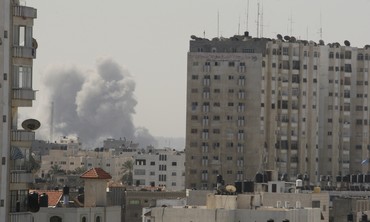
IAF Strike in Gaza REUTERS
Car damaged by a rocket attack in Ashdod REUTERS
It is all too common. This continual cycle of violence which seems to have no end in sight deals a significant blow to civilian populations, and not just in injuries and casualties. Since the informal cease fire on March 13th, over 20 rockets have fallen on Israel from Gaza. During this entire escalation of violence, nearly 1,000,000 people had to endure constant exposure to violence as over 300 rockets fell on Israel in the south. Children and adults in southern Israel were confined to bomb shelters as school closed for hundreds of thousands of students, severely disrupting peoples' lives and livelihood. Sadly, this isn't anything new. It is just one escalation of many, and likely many more will occur.
Children in an Ashkelon bomb shelter adapted from a drainage pipe AFP
For me it is very difficult to deal with. It prompts me to learn more about the political situation, what diplomatic efforts are being done on both sides of the conflict, and how the recent violence has been portrayed in the media. In an effort to boost views to my blog, I posted it on a public forum. One of the comments I received was that everyone forgets about Najd, the arab village that was expelled in 1948 during the war of independence. Interestingly enough, Sderot was built on top of Najd years later. It seemed that this was supposed to mean that the difficulties of Sderot's residents are unimportant so long as the former residents of Najd are still refugees.
While historically, this may be true, it is wrong to blame the civilians for what happened. Nearly 70 years later, chances are most Israelis haven't even heard of Najd, a small villiage of under 700. Now, with Sderot having a population of over 25,000 people, it is a much different situation. The fact is, most people, in Gaza and Israel, just want to be able to continue to live as normal people, carry on their lives uninterrupted, work, and raise a family. Lets forget about the blame game for a moment. Lets think about the civilians. People need help, Natal is trying to provide it, and I am just trying to get the word out, that there are many here who need help. While typically Palestinians don't ask for help from Natal, they are welcome. In Israel, Post Traumatic Stress is not so atypical. Natal provides help for those who need it, despite age, religion, or political affiliation.
Natal hears, "Thousands of children and adults have been exposed to consistent violence and many are suffering psychological trauma as a result," and they respond with, "Those who need help, please call us at 1-800-363-363."
Wherever you stand on the conflict, whether you are far left, far right, center, anti-zionist, zionist, or whatever, it is clear that people need help.

No comments:
Post a Comment