It's strange. I remember writing my first post on this blog about unpacking my bags, excited for my new life in Tel-Aviv. Here I am, months later, writing a post about packing up.
This year has been hands down, the most powerful time of my entire life. Everything I knew as normal has been turned upside down. I see the world in a different way, having met friends who span the entire globe who feel like family at this point. While being here in Israel, I got to volunteer for an organization who I believe to be one of the most important in this country. When signing up for my volunteering, I wanted to work somewhere that provided a neccesary service to Israel--something that truly made a difference. While I wasn't the man behind the screen, taking care of patients, I truly feel like I got to contribute to the place, providing an understanding of what it does and how important it is to Israel.
Natal is an organization that was originally founded to help soldiers deal with post-traumatic stress after difficult tours of duty. Eventually, however, it found that people from all across Israel suffer from post-trauma--that it is truly a national disease. Thousands have been effected by terrorism here and by war. Everyone is connected somehow to a tragic accident--whether a family member or a friend was taken, whether it was witnessing a suicide bombing, whether it is living under the shadow of daily rocket fire, or whether it was living in an army base in constant fear of death.
Before getting into what Natal does, one has to ask themselves, "what happens when an entire society is affected by a debilitating psychological illness?" PTSD causes its victims to break down sometimes to the point where they can no longer live normal lives, unable to work or raise a family. It causes people to hate. It confuses people. So if an entire society that constantly lives under the threat of war and terror fails to develop resiliency through trauma, then they will break down. Peace in the middle east, if however possible, will also fail. Finally, hope will fail, and when hope fails, all else is lost.
I came to Israel with all sorts of opinions about the conflict, but as I learned more and more, I came to find that there is no perfect stance. There is a war of values, of how the history is to be written, and a real war on the ground. I find today, that I can lean one way or the other on any given day. When you look at this conflict on a deeper level, and try and comprehend the way that the average person lives through it, it brings about completely different emotions. People are driven to find revenge. The effects of Post-Trauma are poisonous, and they breed hate. We can try to create political solutions, but they can only help so much. So long as both sides harbor hate and seek revenge for each others actions, prospects of peace--a real lasting peace where both sides can work together for a better future--will break down.
Since working here, the way I travel has changed. When hiking in the Golan heights, I could not get the thoughts of the wars out of my head. I saw ruins of villiages, and I felt compassion, but at the same time, a complete understanding that things are just screwed up. The only way to alleviate the pains is to treat the scars.
I remember staring at the blades of grass around me as I sat eating lunch. During war, these fields would endure constant artillery fire. They would be burned. They would be trenched. But years later, with sunlight and rain, they grew again, and look as much the same as they did before.
War can change things. Lands will change ownership. People will be hurt. However, the only way to get past what has happened is to heal, to grow. We may not be able to find a political solution any time soon. However, we can change the way we think. We can heal from what happened to us. We can forgive. We can be resilient. If we are strong, and don't allow the trauma to kill us, we can learn from it and grow taller than we have ever been.
Israel lives in constant turmoil, but somehow is in the OECD, boasts some of the best technology in the world, has a somewhat decent economy, and a democracy. If we had allowed the Holocaust and all of its trauma to break us down, we would be dead. However, after thousands of years of persecution, we decided to rise up and create something for ourselves--and we sure did. So long as we can learn from our pain, and use it motivate us, anything is possible--even peace.
I want to thank Natal so much for the opportunity it gave me to reflect on Israeli culture, Jewish culture, my perspective on life, and who I am. I feel now a much stronger drive to help my community. I feel much more compassionate to those who hurt. They say, "your only as strong as your weakest link." Therefore, it is our duty to strengthen those of our society who are hurt, broken down, and unable to move on. It is our duty to grow.
Monday, May 14, 2012

Thursday, May 3, 2012
Remembering and Growing: Israel in 2012
From Yom Hashoah to Yom Hazikaron to Yom Haatzmaut, the Israeli spirit lingered in the air. Each holiday celebrates something unique, but all of them are very much intertwined. The basic idea was to remember the fallen--in the Holocaust, in Israel’s wars, and from terrorism--and for the memory of their lives to remind us of the cost that Israel has endured in order to exist. Through the week, I looked back at the year behind me and how my perceptions about this state has changed.
I came here with all sorts of notions, uncertainties, and opinions, but as I became more educated and had the opportunity to see this place with my own eyes, I found it much harder to take a stance on the conflict. I looked around me saw extremism, war, hatred, and terrible memories on the faces of people I saw.
Trauma has truly become a part of Israeli culture. Every person you talk to has a story of a loved one who has fallen in battle, a friend who has been taken by terrorism, or about a community learning to cope with constant rocket fire. Hearing such things evokes a lot of emotions. However, ef we are unable to control those emotions, the prosperity of this country is in danger. We must have hope. Hope lead to the creation of this country, to the survival of the Jewish people, and hopefully one day will lead to peace. In order for this country to truly flourish--to actualize to its full potential and solve its problems--it must face its dark history and learn to grow from it.
During Yom Hazikaron--Memorial Day, my program gave me the opportunity to go visit a military cemetery. While there, they gave us rags and memorial candles, in order that we find an unattended grave, and take care of it (a great deed in Judaism). Upon entering the cemetary, we found thousands of people with smiles on their faces. It looked more like the scene of an art fair than a memorial service. I walked through isles of graves, but I couldn’t find a single one that hadn’t been attended to. Every grave had a soldier and a family in front of it, with flowers and stones all over it, and a memorial candle or two on the side. So I walked around as a spectator, a visitor, just as I have been for 8 months now.
Eventually, as expected, I heard a siren--indicating the moment of silence. Suddenly, the crowd that seemed so uplifted turned somber, as the thousands of people around me looked down and closed their eyes. Soldiers put up their salute. Everyone was quiet for two minutes. It was truly moving.
The same thing happened during Yom Hashoah.
I was walking through the street on the way to Natal, and the siren went off. The bustling traffic came to a dead halt as everyone got out of their cars at the biggest intersection near me, and stood in silence to remember the fallen. I saw no fear in anyone's face. I saw hope. I felt hope. The Jewish people have come so far, from exile after exile, to pogrom, to holocaust, to war after war, and now, in 2012, we are as strong as ever. We have a country, and we can very much be Jewish without being religious.
He said, “Yeah. On several occasions I have just barely missed a rocket attack. If I had been a few meters away, there's a chance that I wouldn't be here today talking to you. It is very difficult living there. With the raids overhead nearly every day, we live in constant fear. It is difficult to live a normal life.”
I told him how I volunteer for Natal, an NGO that provides treatment for victims of PTSD.
He told me, “That’s great. But come live in Sderot, and you won’t have to be a volunteer for any organization. Just living here you become one. We help each other. If we didn’t have our neighbors, we would be in shambles. I am a religious man, you can see by the kippa on my head. I feel safe, because I have hope. I trust that there is someone looking out for me, for my friends, and for my family.”
At that point we split. I saw my best friend enacted into a military which is defending those residents in Sderot. With all the smiling faces, the parents taking pictures, and soldiers making an oath, I felt something special. There truly is someone watching over them. There is the army. There is Natal. There is us--the Jews outside Israel, the common Israeli, the Jewish people. We are strong today and for a while from here on out, watching over each other just as we have for thousands of years. Through all the suffering, hardship, and trauma, we have held each other’s hands, and asked how we could help. In 2012, as small as the Jewish people are are, as dwindling as their population is, we aren’t going anywhere. Just as Israel has opened its hand to any Jew in despair, in search or refuge or a fresh beginning, we must open our hands to the Israeli who suffers, who lives in despair, and who needs help. That’s what Natal is here for.
I came here with all sorts of notions, uncertainties, and opinions, but as I became more educated and had the opportunity to see this place with my own eyes, I found it much harder to take a stance on the conflict. I looked around me saw extremism, war, hatred, and terrible memories on the faces of people I saw.
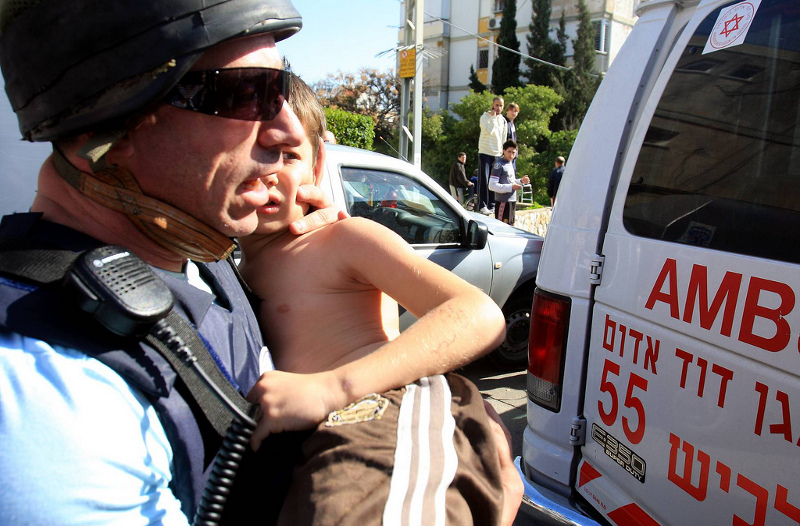 |
| An Israeli Child Wounded from A Rocket Attack is Taken to an Ambulence |
Trauma has truly become a part of Israeli culture. Every person you talk to has a story of a loved one who has fallen in battle, a friend who has been taken by terrorism, or about a community learning to cope with constant rocket fire. Hearing such things evokes a lot of emotions. However, ef we are unable to control those emotions, the prosperity of this country is in danger. We must have hope. Hope lead to the creation of this country, to the survival of the Jewish people, and hopefully one day will lead to peace. In order for this country to truly flourish--to actualize to its full potential and solve its problems--it must face its dark history and learn to grow from it.
During Yom Hazikaron--Memorial Day, my program gave me the opportunity to go visit a military cemetery. While there, they gave us rags and memorial candles, in order that we find an unattended grave, and take care of it (a great deed in Judaism). Upon entering the cemetary, we found thousands of people with smiles on their faces. It looked more like the scene of an art fair than a memorial service. I walked through isles of graves, but I couldn’t find a single one that hadn’t been attended to. Every grave had a soldier and a family in front of it, with flowers and stones all over it, and a memorial candle or two on the side. So I walked around as a spectator, a visitor, just as I have been for 8 months now.
 |
| Israeli Military Cemetary |
Eventually, as expected, I heard a siren--indicating the moment of silence. Suddenly, the crowd that seemed so uplifted turned somber, as the thousands of people around me looked down and closed their eyes. Soldiers put up their salute. Everyone was quiet for two minutes. It was truly moving.
The same thing happened during Yom Hashoah.
I was walking through the street on the way to Natal, and the siren went off. The bustling traffic came to a dead halt as everyone got out of their cars at the biggest intersection near me, and stood in silence to remember the fallen. I saw no fear in anyone's face. I saw hope. I felt hope. The Jewish people have come so far, from exile after exile, to pogrom, to holocaust, to war after war, and now, in 2012, we are as strong as ever. We have a country, and we can very much be Jewish without being religious.
A Highway Stops completely for Yom Hashoah's Memorial Siren
One thing I have learned while being here is that Israel, whether you like it or not, is today the global center of Jewish culture. I’ve recently been reading a book recently called Far From Zion, in which the author travels the globe studying the Jewish communities in the strangest of places. He wished at the beginning to do this in order to prove that the Jewish people doesn’t need to be binded to the Zionist state of Israel. However, everywhere he went he found Israel. Every dwindling community that had been forced to go through generations of oppression was mostly in Israel or fully assimilated. Every prosperous community was keeping Israel in mind. Most of all, even in Africa, Bosnia, and Burma, the Jews prayed in their synagogue in the direction of Jerusalem. Because of this country, we are as much together today as we have ever been.
But we cannot forget the costs. Israel cannot forget dreams of peace and “crush our enemies” forever. We need to find lasting solutions. It is very difficult, as nearly anyone here can tell you, and at times it very much seems impossible. However, we must never lose hope. In order to address a solution, we must first address our own problems. Hundreds of thousands of citizens are under fire by rockets on a sub-regular basis. Thousands are still having difficulty managing horrific memories of war and terror. Just as the Jewish people were able to rise above their difficulties in order to create the State of Israel, we must heal from our wounds so that we can move on to greener pastures.
Thousands of families have been torn apart when their husbands, wives, and children have been taken in battle or in terror. If their pain goes untreated, they could be unable to function as a member of society--dealing many negative consequences to Israel's ever-changing status quo. As much as the atrocities have hurt us, we can not allow them to break us down. PTSD can totally stop you from maintaining relationships, from sleeping, and even from operating in a work environment. Israel must learn from its pain, and grow.
 |
| Between 74-90% of Sderot Children Display Symptoms of PTSD |
Yesterday, on the way to my friend’s initiation ceremony into the Israeli army I met a man on the side of the road going the same way. We walked from the bus stop for a good half hour, discussing this very subject of PTSD. He was from Sderot, the city bordering Gaza that has been constantly exposed to violence for over ten years. I asked him about the rockets, and how they affect him and his community.
 |
| A House in Sderot Damaged by Rocket Fire from Gaza |
He said, “Yeah. On several occasions I have just barely missed a rocket attack. If I had been a few meters away, there's a chance that I wouldn't be here today talking to you. It is very difficult living there. With the raids overhead nearly every day, we live in constant fear. It is difficult to live a normal life.”
I told him how I volunteer for Natal, an NGO that provides treatment for victims of PTSD.
He told me, “That’s great. But come live in Sderot, and you won’t have to be a volunteer for any organization. Just living here you become one. We help each other. If we didn’t have our neighbors, we would be in shambles. I am a religious man, you can see by the kippa on my head. I feel safe, because I have hope. I trust that there is someone looking out for me, for my friends, and for my family.”
At that point we split. I saw my best friend enacted into a military which is defending those residents in Sderot. With all the smiling faces, the parents taking pictures, and soldiers making an oath, I felt something special. There truly is someone watching over them. There is the army. There is Natal. There is us--the Jews outside Israel, the common Israeli, the Jewish people. We are strong today and for a while from here on out, watching over each other just as we have for thousands of years. Through all the suffering, hardship, and trauma, we have held each other’s hands, and asked how we could help. In 2012, as small as the Jewish people are are, as dwindling as their population is, we aren’t going anywhere. Just as Israel has opened its hand to any Jew in despair, in search or refuge or a fresh beginning, we must open our hands to the Israeli who suffers, who lives in despair, and who needs help. That’s what Natal is here for.
 |
| Me With Franco After He Was Initiated Into the IDF Tank Unit, Shirion |
Subscribe to:
Posts (Atom)